Saturday, September 1, 2012

An Amazing Hill Station:

It was 22nd July and after lot of negotiation and bargain with autowallahs, I finally reached IIT M campus to begin a new voyage of 2 years at DoMS. The metallic IIT M logo embossed at the entrance gate with motto “Siddhirbhavati Karmaja” (Effort Yields Success) makes you realize the reason and purpose of being here. The beautiful lush green 620 acres campus, which is home to deer, blackbucks, birds and notorious monkeys, compels you to explore every corner of it. Monkeys may create lot of trouble if they somehow got into hostel room. One day I forgot to shut the back door of room and when I returned, a monkey was feasting on fruits kept on my table and had created a big mess over my notebooks. In fact, I was told that there have been cases of cell phones being taken away by monkeys in past.

But, here, people really love and care for animals and which is why students of IIT M are not allowed to use fuel powered vehicles. At many places in campus, I found this post “Our campus is beautiful and we want to you to enjoying it by driving slow”. Every day I see deer and blackbucks roaming inside Cauvery hostel and on the way to DoMS. Even the outsiders, who come with vehicles to visit the campus, drive slow and stop whenever any deer is running across the road.
Freshers' Party
Our induction program of 5 days was well planned and its best part was interaction with DoMS alumni who are working in banks, consultancy firms and some running their own company. Everything was going very smooth and steady until the seniors came for interaction. My life became hectic and sleep was a luxury. Imagine,  you are comfortably sitting in class room, enjoying and participating in the various activities during the interaction sessions with seniors. Now imagine your surprise to see the faculties sitting at the back. The sessions started at 9 pm and you just don’t realize how time flies by. 5 hours seemed like 5 minutes. At 2 am, when the session is over, seniors tell you to give a formal presentation as a group at 9 am on marketing a product. The topic and team members are mailed at 5 am and topics are like Pregnant Bride, Pant with a hole, Lip kiss glue and many more. How can you do marketing of Pregnant Bride? And that too when not even a single class of marketing has taken place. There was hardly any time for preparation and this was something which I never experienced even during my Job.
 Such sessions continued and kept us very busy but I liked it. Soon they were replaced by the selection process of various committees. Essay /GD/ Extempore topics were given in selection process were also of same category with words never heard before and I was totally clueless over what to write in my essay. The only thing I can recall about my essay is that I wrote “sleep “and “slumber” many times.
 I felt very happy on my decision to join DoMS after attending the PVR sir’s lecture on marketing. All his assignments are based on understanding and field experience. LSG sir’s class gives lot of motivational drive and energy. But subjects like Microeconomics and DAM are very demanding and there is a fear of surprise quiz in every DAM class. Sometimes it becomes very hard to keep track of various members team for different assignments and projects.
 There are some occasions when you just forget everything and enjoy. The ball was set rolling by our welcome dinner thrown by the seniors and the dept. Yes! It was our Fresher’s Night where I danced nonstop and enjoyed amazing performances given by my batch-mates and seniors. Everything was superb, the food, decoration and the dress code of devil horns for boys and flower crown for girls. And to add more stars to the night, Prof LSG (DSW) came and sang classic rock and Malayalam songs.
DoMS is a really beautiful hill station as LSG sir always says and I have spent almost one month here. Looking forward to my time here!!!

Adios….

Courtesy:
Pawan Koserwal
DoMS Interface
Batch of 2014

Tuesday, April 3, 2012

Applications of Management Principles in Healthcare

With the advent of mega-hospitals and the growth of corporate hospital chains, the requirement for MBAs to oversee management in the healthcare industry has surged. Doctors and nurses are generally not trained to address management issues in a hospital. Therefore, managing the processes in a healthcare organization is absolutely vital. To discuss the importance of management principles in healthcare and how we as MBAs can contribute to this sector, on 22nd March 2012, MBA Invitation Lecture Series invited Mr. Manick Rajendran, CEO Lifeline Hospitals. He is also a consultant for the US Government Healthcare initiatives under ARRA (American Recovery and Reinvesting Act).He is an alumnus of IIM Bangalore and has worked as a Vice-President for Deutsche Bank.
Mr. Rajendran initiated the talk with a question: What is important for the healthcare industry? After gathering various responses from the audience he emphasized on three points: manpower management, strategic leadership and emulating best practices. Talking about what the healthcare sector offers to MBA students, he again identified three key points:
·         It gives a sense of job satisfaction as we can contribute to the society
·         It is one sector which is least affected by economic recession
·         India is a huge market offering  a lot of potential in this sector
After giving us a basic overview of the healthcare sector, Mr. Rajendran took the conversation towards describing how they implemented management principles in Lifeline Hospitals. He acquainted us with the concept of Hoshin Kanri which is a strategic management methodology based on total quality management. The concept, popularized in Japan, aims to make an organization the best in the field. Mr. Rajendran explained how they implemented the concept of Hoshin Kanri by focusing on zero defects.
Talking about manpower management, he gave the reference of Steven Covey’s Seven Habits and how it helped him to get the best out of people. He also talked about change management and the various aspects involved with its execution. According to Mr. Rajendran, one should never ask anyone to change; instead, a sound manager should bring about that change by engaging people in interesting activities. He cited various anecdotes and examples of how he was able to execute the aforementioned theory.
Mr. Rajendran talked about the significance of experiential learning and how he has implemented it in Lifeline Hospitals. He also gave a demonstration of experiential learning through a game of Chinese whispers by choosing 15 volunteers from the audience. It was carried out to show the effect of gossip and why it should be avoided in organizations.
Mr. Manick Rajendran followed a really interactive approach for the lecture: kept everyone involved and interested. If I can put it in three words, I would say the lecture was relevant, valuable and spellbinding.
Compiled By:
Aditya Ghai
MILS | Batch of 2013
Photo Courtesy:
Mauryanath Das
DoMS Interface | Batch of 2013

Tuesday, March 27, 2012

Anecdotes of a colourful Holi


IIT-Madras always has an air of something waiting to happen…And indeed the campus welcomes festivals like families welcoming their NRI relatives during homecoming. The true spirit of the whole affair is reflected by the fact that celebrations cut across all religions and barriers, be it Diwali or Christmas, Onam or Durga Puja,  festivals spark off an excitement and create a buzz among all the IIT’ians. We were waking up to one such day ,the day of colours , our very own special fest – Holi.
            The late- riser’s at the IIT hostels, (I always form a part of this crowd), woke up to commotion and music interrupting their very precious morning sleep. Some of them, the (un)fortunate souls, who went to investigate what the whole tantrum was all about, were in for a surprise. They just had to reach the hostel porch to get the shock of their lives - seeing the alien-like hostelites (all of them were quite unidentifiable as humans after being bathed in colours from top to bottom).
            These poor souls, including me, were welcomed with howls of joy from the predators who  had  just spotted their next prey. With loud shouts they swarmed upon us in no time, pouring bucket loads of colour. Those who were quick enough to understand what was about to happen to them ran for spots to hide, but not with much success as they were dragged or carried back to “the” spot. It was truly a day of “No Escape”, no friends or foes; today there were only hunters and the hunted.
            After they had all the fun of reducing us to coloured zombies, with shirts torn and wet egos, we were offered sweets and snacks. During the handshakes and hugs that followed , few among the attackers knew that the hunted were hatching plans of taking revenge , and very soon at that. The day had just begun, and a colourful one it had to be.
            Once the hostel celebrations were over , it was now the time for us to march on to our respective departments for Phase two .The roads were filled with channels of colours. I was forced to notice a girl, who had just come out of her department after spending her entire night at the research lab, was chased by a bunch of guys armed with colour-guns. She ran for cover to the nearest trees, throwing away all her books on the way. There were gangs doing a campus march, dancing and spraying colours. I couldn’t help but notice a few deers, running around, covered with spots of uncharacteristic red and blue. The joy was shared among all IIT’ians, humans or otherwise.
            DoMS had it’s own share of events with the MBA students, research scholars and exchange students joining in on the fun. Those who were tired of it, sneaked away back to hostels and freshened up, but only to be welcomed again with a fresh splash of colours. Anyone who was spotted neat and tidy was not supposed to be spared, not today. Eggs were thrown ,to have that long lasting effect. It was a massacre of colours and smiles.
            As we neared the dusk, we realised that another special day at the campus had come to an end and as always we wished it hadn’t. The colours stayed on, perhaps to last for another bath or two , but the joy it spread will stay on forever. A colourful memory remains . . .


Submitted By:
Jagadish G.
Class of 2013
DoMS | IIT Madras

Photo Courtesy:
Rajan Vishwadeep
Class of 2013
DoMS | IIT Madras

Tuesday, February 21, 2012

Reflections on my turning points- Personal, professional, social and philanthropic

“Luck is all about being prepared to grab opportunities”- Mr. Kris Gopalakrishnan


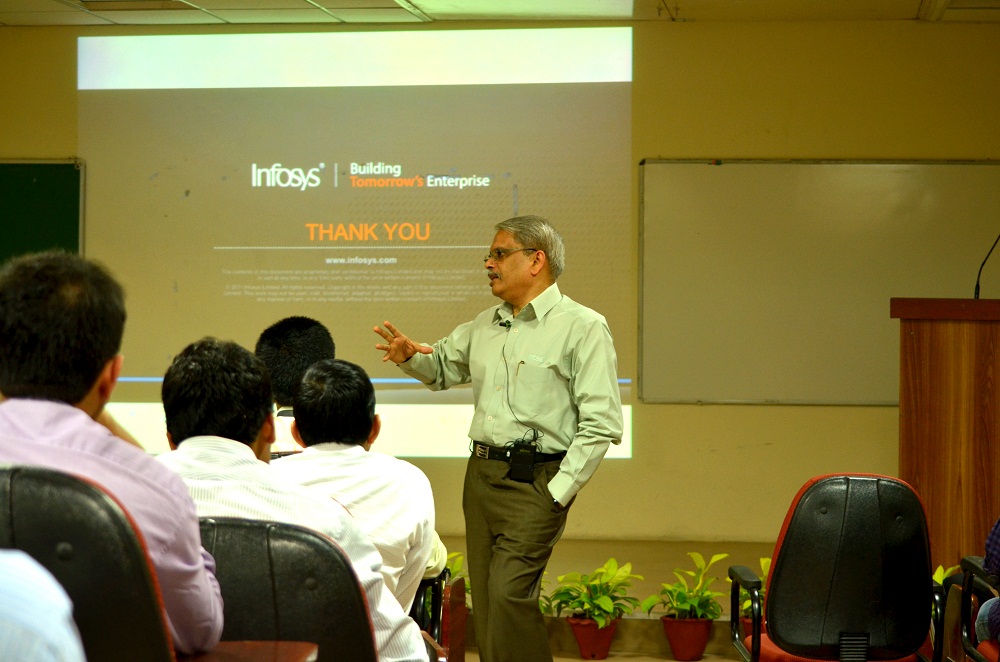
It was February 9th 2011; the stage was set for Mr. Kris Gopalakrishnan to deliver one of the best lectures MILS has ever hosted. Mr. Gopalakrishnan, an alumnus of IIT Madras, is one of the seven founders of Infosys Ltd. He took over as the CEO and Managing Director of Infosys Ltd. from Nandan Nilekani in 2007 and is now serving as the co-chairman.
Mr. Gopalakrishnan began the talk with the citation of Global Delivery Model (GDM) that was pioneered by Infosys. GDM ensures the effective/ efficient distribution of application and business process lifecycle activities and resources, while ensuring their integration; key drivers of GDM being: processes, quality, tools, knowledge management, program management and risk mitigation. After discussing the key points of GDM, he stated that IT industry has a full range of offerings and it has a long way to go.
Mr. Gopalakrishnan shared some anecdotes from his entrepreneurial journey; how he was able to contribute to the inception of Infosys with the other six founders. After passing out from IIT Madras, he joined Patni Computers. Thereafter, the idea of starting off a venture struck them (all 7 founders), and eventually he took a loan from his family for setting up Infosys in 1981. The founders were denied of loans by banks, which motivated them to become a zero “debt” company. Mr. Gopalakrishnan gave a useful tip for fund-raising when he quoted “The best time to raise funds is when you are doing well”.
He gave some interesting insights into what aspects a firm should concentrate on to be successful. He stressed on the importance of teams; how valuable it is for the team members to have similar values and aspirations. Referring again to Global delivery model, he said “cheaper is temporary, but faster is permanent” to emphasize on the fact that “competitive advantage based on just cost is temporary”. Another interesting thought that he shared was about leadership and its significance. Referring to Infosys, he said final decisions are made by the CEO and success of company is kept above individual success as far as any decision is concerned.
Taking Infosys as an example, he said that it’s imperative for an organization to pace itself and “adapt the model to suit constraints”.  Infosys laid its foundation in the years 1991-1999. It became the first Indian company to get listed on US exchange. 1999-2004 was the “scaling-up” period; during this period they reached the mark of one billion dollars in terms of revenue. 2004-till date is the period of diversification and globalization for Infosys. Infosys is still growing at the rate of 16% which is tremendous as far as current global scenario is concerned.
It was an honor to be a part of the audience to which Mr. Kris Gopalakrishnan was addressing. The lecture was intellectually stimulating and “constructive” if I can put it that way, for an MBA student.


Compiled By:
Aditya Ghai
MILS | Batch of 2013


Photo Courtesy:
Mauryanath Das
DoMS Interface
Batch of 2013

Tuesday, February 7, 2012

Globalizing the Aravind Way and Aurolab


The MBA Invitation Lecture Series (MILS) was honoured to host Mr. Thulasiraj Ravilla, Director-Operations and Board member, Aravind eye care system for a lecture on “ Globalizing the Aravind way and Aurolab” on 2nd  February 2012. Mr. Ravilla is an alumnus of IIM Calcutta. He also serves as the head of LAICO-Aravind Eye Hospital Care System and the initiative “VISION 2020- The right to Sight-India”.
Aravind’s community activities
Aravind Eye Hospital was established in 1976 by Dr. G. Venkataswamy as an 11- bed clinic, dedicated to provide compassionate services for sight. To realize its mission, it was important for Aravind to understand the bottom of the pyramid. Mr. Ravilla stated that “the poor are a lot more sensitive” than what we presume them to be. The under-privileged have to manage fluctuating incomes and survive under difficult conditions.
As part of its mission, Aravind eye hospital organizes community activities in villages which occur as often as 2000 times a year. Villagers are tested in the camps and then taken to hospitals. These camps were able to reach around 6-7 lakh people per year. This seems to be a humungous figure as far as numbers are concerned, but as Mr. Ravilla said, percentage-wise the reach was just 7%. So, Aravind hospitals changed their approach and started thinking about a cost-effective solution to expand their reach.
The new approach
Mr. Ravilla with Prof. L.Prakash Sai
Aravind eye care along with its community outreach programmes, established permanent facilities in villages, staffed by technicians (as it is tough to get doctors to work in villages). These facilities allowed patients in rural areas to be remotely diagnosed by ophthalmologists at the base hospital. At the hospital, they incorporated plenty of cost-effective measures, one of which was low-cost imaging (reducing the cost from $25000 to $250). The entire consultation fee was just Rs.20. This programme was highly successful and achieved 80% penetration.  
Emphasizing on the hospital’s efficiency, Mr.Ravilla quoted that the key lies in “utilizing the bottleneck resources fully”. In Aravind, around 6-8 surgeries are performed per hour as compared to a normal operating time of 1 hour for any other hospital.
Aravind’s global footprints
From an 11 bed hospital in 1976, Aravind Eye care has grown into a 4000 bed hospital, housing a staff of more than 3000. A day at Aravind involves 1000 surgeries and more than 6000 outpatients which makes it the largest provider of eye care in the world. The hospital has received numerous international awards (including Gates Award) and there are case studies done by B-schools of the stature of Harvard Business School, IIM-A and many more. Mr. Ravilla elicited that their “philosophy is not to strive for dominance, but to create a market”.

Aurolab- manufacturing arm of Aravind Eye hospital
Before citing the achievements of Aurolab, Mr. Ravilla explained how a modern cataract surgery is done. It gives normal vision without glasses by replacing the natural lens with an artificial lens called intraocular lens (IOL). When it was initially introduced, the price was $100 which the poor just could not afford. Aurolab, with its effective procedures, brought down the price to $10(now $2). Aurolab manufactures IOL, sutures, surgical blades and other equipments. Since its inception in 1975 as a non-profit organization, it has been instrumental in manufacturing innovative products like Latanoprost (Refrigeration- free medicine) and Vozole(anti-fungal eye drops). The impact of Aurolabs has been two-fold: increased availability and affordability; reduction in prevalence of cataract and other eye ailments. The high quality and low cost products of Aurolab have also forced the competition to do the same.
In a nutshell, Aravind eye care system is a coherent organization led by a bold leadership. As one of the best case studies, it gives us the lesson of going the extra mile and growing beyond individual self.

Compiled By:
Aditya Ghai
MILS,
Batch of 2013

Photo courtesy :
Rajan Vishwadeep
Class of 2013


You are visitor number